

16.12.2025 | Andere
Advertising information from Metzler Asset Management GmbH
From a macroeconomic perspective, 2026 will be marked by a new normal following the interest rate turnaround and Donald Trump's return to the White House in early 2025. The combination of a sustained AI investment boom, global key interest rate cuts, and a significantly more expansionary fiscal policy—especially in Europe—will lay the foundation for a stable, albeit moderate, upturn in the global economy.
At the same time, vulnerabilities in the financial system are increasing: rapidly growing private debt markets, high government debt, and highly concentrated valuations in the US stock market.
The most important structural growth driver in 2026 will remain the AI boom. Large US technology companies continue to invest heavily in data centers, semiconductors, software infrastructure, and telecommunications and data networks. The planned capital expenditure of the major platform companies – such as Amazon, Alphabet, Microsoft, Meta, and Oracle – will rise to over US$400 billion in 2026. It is striking that although these sums seem impressive, the average investment ratio in relation to GDP is still below the historical extremes of previous investment waves such as railways, electrification, or digitization. The investment boom is thus well advanced, but by no means exhausted.
In the baseline scenario, the AI boom remains intact. Investments continue to rise without reaching excessive levels. The large technology companies will continue to generate high positive free cash flows in 2026, remaining relatively independent of turbulence on the capital markets. Overall, the macroeconomic growth impulses outweigh the financial risks. The momentum in the AI sector thus acts more as a growth engine than as an immediate systemic risk – provided that profit expectations remain within a realistic range.
Sources: FactSet, Goldman Sachs, Metzler
Sources: Bloomberg, Metzler; as of September 30, 2025
Sources: The Economist, Reinhart and Rogoff, IMF, Metzler — * Average across 22 countries ** Weighted average across 41 countries
Sources: BofA, Bloomberg, Metzler; as of November 30, 2025 — August 2010: 313; November 2020: 255; November 2025: 316
Sources: Bloomberg, Metzler; as of October 31, 2025
| Oracle |
| -10 |
In 2025, Europe began to emerge from a period of stagnation. In many countries, it is clear that a combination of growth-oriented fiscal policy, structural reforms, and a stable labor market situation can lay the foundation for a new European upswing.
For Germany, 2026 clearly points to a turning point. Public investment is rising significantly, particularly in infrastructure, defense, and energy networks. Unused funds from 2025 will flow into demand in 2026, bringing the fiscal stimulus to around 0.9 percent of GDP. In an environment of still moderate capacity utilization and slightly negative real interest rates, we assume a high fiscal multiplier of around 1.0. Industry will benefit from improved predictability in energy and defense projects and will be able to adjust capacity in a timely manner.
At the eurozone level, the unemployment rate is likely to fall below 6.0 percent in 2026, provided that the current course of investment and reform is consistently pursued. At the same time, inflation will remain just below 2.0 percent, which is well in line with the ECB's mandate. This will create an environment in Europe where moderate growth and price stability are not at odds with each other, but rather support each other.
Europe is also gradually assuming a more important role in security policy. If the US government continues to focus more strongly on the Pacific region, Europe will have to assume a major responsibility for supporting Ukraine in the long term – with corresponding consequences for defense spending, fiscal policy, and the internal structure of European economies.
The positive baseline scenario is offset by significant risks. One key risk is that the high expectations for the economic prospects of artificial intelligence will not materialize to the extent hoped for.
One initial warning sign is the increasing circularity of financial flows. AI companies are investing in each other's equity, revenues, and infrastructure projects. This creates a close network of interdependencies that reduces resilience in the event of a crisis and creates false incentives to artificially inflate growth rates. At the same time, the capital requirements of individual AI providers are enormous.
Added to this is a significant shift in the financial system: a growing proportion of financing is provided through private debt vehicles, whose structures are often opaque and whose liquidity is limited. If the market comes to believe that expectations of future returns from AI technologies have been overestimated, AI and tech stocks could initially face sharp price corrections. In a second step, illiquid private debt portfolios in particular would be affected by write-offs and defaults. Investor confidence could quickly erode, refinancing would become more difficult, and the overall flow of credit would come to a standstill.
At the same time, US life insurers make extensive use of special purpose vehicles to leverage private debt exposures. Structured debt instruments such as FABNs (funding agreement-backed notes) are used to outsource risks that are not subject to the same regulatory reporting requirements as traditional insurance liabilities. The parallels with the period before the 2008 financial crisis are obvious: credit defaults in private debt vehicles could weigh on the balance sheets of US life insurers and trigger a downstream regulatory spiral. As a result, many insurers would be forced to reduce their exposures – with corresponding consequences for the refinancing chain in the real economy.
Another risk is sovereign debt in developed economies, which has reached levels last seen after the Napoleonic Wars in the early 19th century.
Crucially, these high debt levels are likely to rise further, as most countries continue to operate with primary deficits. This shifts part of the vulnerability to crisis from the private to the public sector. Rising interest burdens are increasingly constraining fiscal leeway, while at the same time there are political calls for new growth-promoting measures and social spending. Financial markets are beginning to recalibrate risk premiums, with potentially significant implications for government bond markets and the long-term interest rate structure.
The third key uncertainty in 2026 concerns the development of price levels. Both deflationary and inflationary scenarios are plausible, with inflation risks predominating.
The risk of deflation typically arises when there is a break in the private credit cycle. Major problems in segments such as private debt, leveraged loans, or high yield could trigger a wave of credit defaults. Bankruptcies directly reduce the money supply, banks and non-banks become more cautious in lending, and the economy cools down. This would create an environment dominated by disinflationary or even deflationary trends. However, the volume of these markets – around USD 4.0 trillion – is significantly smaller than, for example, the US mortgage market before the financial crisis, which was worth around USD 10 trillion, so the risk of systemic deflation currently appears limited.
The risks of inflation are much more serious. In the US, high primary deficits and steadily rising government debt are coinciding with a cycle of interest rate cuts that could push interest rates back below the inflation rate in the medium term. The US can hardly afford permanently high real interest rates if it has to take on more and more debt to cover growing interest payments. This is putting the US Federal Reserve under increased political pressure. Although the parallel with the start of the Turkish inflation surge in 2021 is not entirely transferable, the basic pattern of political influence on monetary policy is comparable – with potentially weakening effects on the US dollar. In the eurozone, inflation risks appear more moderate, but could intensify significantly if extensive fiscal programs – in Germany, for example – coincide with key interest rates that remain too low for an extended period of time. Overall, the probability of a renewed rise in inflation in 2026 is significantly higher than that of a pronounced deflationary shock.
The major central banks began a cycle of interest rate cuts at the end of 2023, the cumulative extent of which is now comparable to the easing phases after the financial crisis or during the pandemic. Monetary policy is thus providing the global economy with noticeable tailwinds.
However, we expect a mixed picture for 2026:
Despite the expected key interest rate cuts in the US, the outlook for government bonds remains ambivalent. Since April 2025, risk premiums on long-term government bonds have been rising slowly but steadily as markets increasingly price in high debt levels and structural deficits. The status of US Treasuries as a safe haven has also been tarnished. Periods of sharply rising volatility on the stock markets, as measured by the VIX, no longer automatically lead to falling yields on US government bonds .
During the coronavirus crisis in 2020, Treasuries initially behaved in the traditional manner: government bond prices rose when equities fell in March/April, up to a VIX level of around 55. Above this level, however, the correlation reversed and both equity and government bond prices declined. During the turmoil in April 2025, this tipping point was already at a VIX level of around 35.
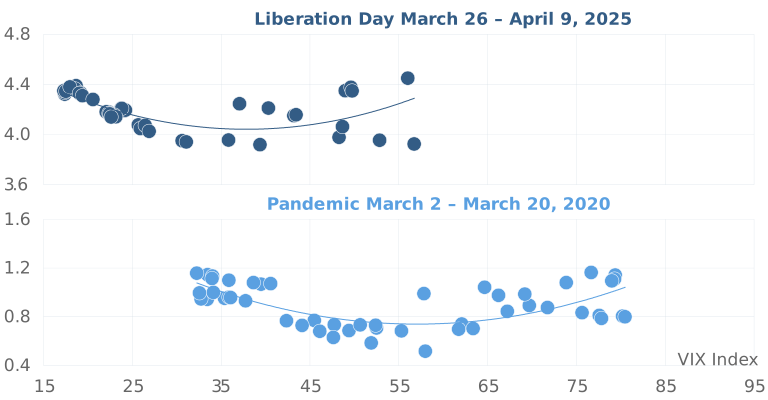
The interpretation is obvious: above a certain stress level, market participants no longer fear only valuation adjustments on the stock markets, but also the real economic consequences of a possible recession. In such a scenario, the US unemployment rate could rise from its current level of around 4.4 percent to between 6.0 and 8.0 percent. Falling tax revenues and rising social spending would quickly push the government deficit to between 12 and 15 percent of GDP – levels reminiscent of Greece in 2010.
For government bonds, this means limited price potential for long-term maturities combined with increased extreme risks – especially in scenarios where government bond markets are pricing in significantly higher risk premiums.
The corporate bond market in the eurozone is showing a pronounced appetite for risk. Spreads between BBB issuers and A issuers are at historically low levels. The market is thus pricing in a very favorable scenario in which default rates remain moderate in the long term.
However, if tensions arise in private debt and leveraged loans at the same time, this optimism could quickly turn sour. In such an environment, a significant spread widening would be expected for high-yield bonds and lower investment-grade securities. Investors would once again differentiate more strongly between credit ratings and demand quality in a more targeted manner.
Against this backdrop, the A-rated corporate bond segment appears particularly interesting. It offers an attractive yield premium over government bonds without the high vulnerabilities of the riskier market segments.
On the stock markets, the AI boom is not only making headlines, but is now also shaping the market structure. A basket of around 40 AI-related stocks – ranging from large platform companies and semiconductor manufacturers to infrastructure and capital goods groups – now accounts for almost half of the market capitalization of the S&P 500. Investing in the US stock market has thus effectively become a bet on the success or failure of AI, with traditional diversification across sectors taking a back seat.
There is also a valuation aspect to consider. An analysis of the MSCI USA excluding seven large technology companies shows that the earnings performance of the remaining US companies in recent years has been almost identical to that of the companies represented in the MSCI Europe. Nevertheless, the price-earnings ratio of the MSCI USA ex "seven" is around 20, while the MSCI Europe is trading at around 15. It is clear that a great deal of capital has flowed passively into US indices in recent years, significantly inflating the valuations of broad market segments.
The challenge for 2026 is therefore to construct a broadly diversified portfolio across sectors and regions that specifically exploits these valuation advantages rather than blindly accepting them. Europe offers attractive entry opportunities due to lower valuations and fiscal tailwinds. Within the US, selective stock picking away from the big AI winners is gaining in importance.
Sources: MSCI, Metzler; as of October 31, 2025 — * Earnings per share multiplied by the number of shares per company and then summed across all companies ** Amazon, Broadcom, Alphabet, Meta, Microsoft, Apple, Nvidia
Sources: MSCI, Metzler; as of October 31, 2025 — * Earnings per share multiplied by the number of shares per company and then summed across all companies ** Amazon, Broadcom, Alphabet, Meta, Microsoft, Apple, Nvidia
The overall picture for 2026 is as follows:
Base scenario (≈ 70 percent)
Overall, the outlook for 2026 is one of stable but vulnerable recovery. In the base scenario, which we estimate has a probability of around 70 percent, the global economy will grow by around 3.0 percent. Europe will experience an upturn, driven by higher government investment and a falling unemployment rate. Inflation will remain stable and easily manageable overall
level. In the US, the cycle of interest rate cuts will continue, albeit at a moderate pace.
Negative scenario (≈ 30 percent)
In the negative scenario, which we estimate has a probability of around 30 percent, the risks come more to the fore. The bursting of an AI bubble or a loss of confidence in the private debt sector could slow down the credit cycle and dampen investment and consumption at the same time. As a result, a slowdown in growth would be expected. At the same time, the issue of government debt could resurface if markets demand higher risk premiums on government bonds, thereby significantly increasing financing costs.
For investors, 2026 is therefore less a year of spectacular trend reversals than a year of consciously managed risk allocation. Broad diversification remains the central guiding principle. The focus should be on quality segments – in particular European equities with attractive valuations and solid corporate bonds in the A range. Caution is advised with highly hyped individual AI stocks, highly concentrated US stock indices, and long-term government bonds with high duration.
In other words, 2026 offers opportunities, but it rewards those who actively manage risk rather than ignore it.
This document published by Metzler Asset Management GmbH [together with its affiliated companies as defined in section 15 et seq. of the German Public Limited Companies Act (Aktiengesetz – "AktG”), jointly referred to hereinafter as “Metzler“] contains information obtained from public sources which Metzler deems to be reliable. However, Metzler cannot guarantee the accuracy or completeness of such information. Metzler reserves the right to make changes to the opinions, projections, estimates and forecasts given in this document without notice and shall have no obligation to update this document or inform the recipient in any other way if any of the statements contained herein should be altered or prove incorrect, incomplete or misleading.
Neither this document nor any part thereof may be copied, reproduced or distributed without Metzler‘s prior written consent. By accepting this document, the recipient declares his/her agreement with the above conditions.
